

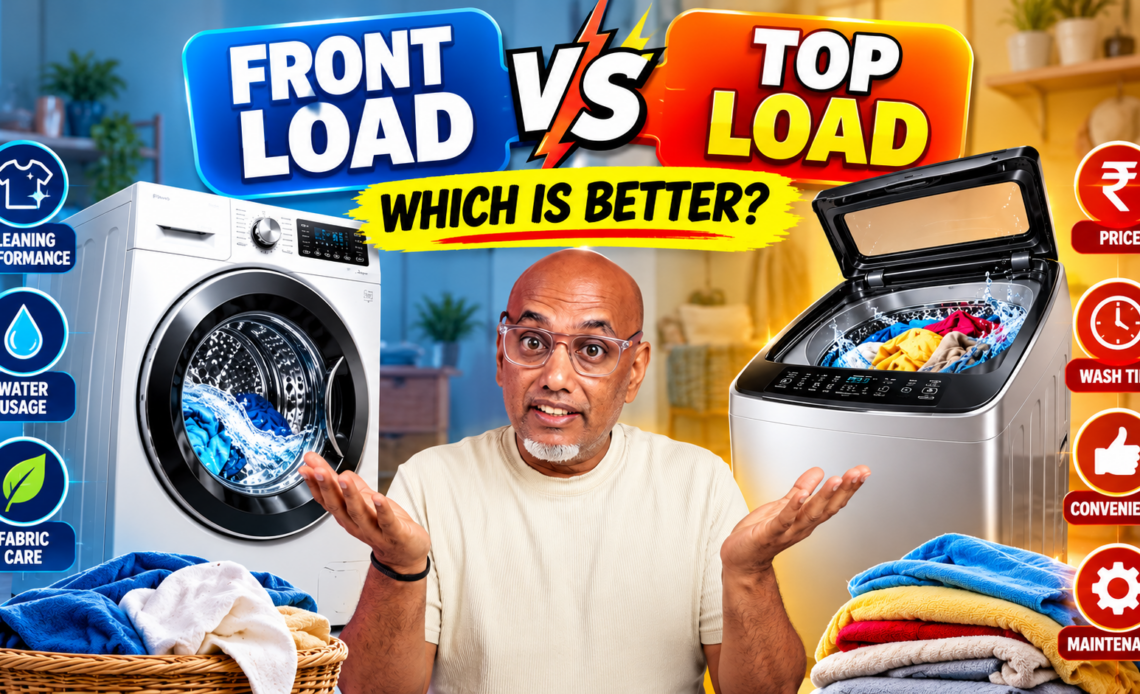
Buying a washing machine can be confusing, especially when you have to choose between a front-load and a top-load model. Front-load washing machines are often associated with better cleaning performance and water efficiency, while top-load machines appeal to buyers looking for convenience and a lower upfront price.
But which one is actually better for your home?
The answer depends on your budget, laundry habits, available space and what you expect from a washing machine. Here’s a detailed comparison to help you make the right choice.
Front Load vs Top Load Washing Machine: Key Differences
| Feature | Front Load | Top Load |
|---|---|---|
| Loading style | Front-facing door | Top lid |
| Cleaning performance | Generally excellent | Good; depends on design and model |
| Water consumption | Usually lower | Often higher, especially traditional models |
| Fabric care | Generally gentler | Depends on wash mechanism |
| Spin drying | Often higher spin speeds | Often lower spin speeds |
| Wash duration | Often longer | Often shorter |
| Loading convenience | Requires bending | Easier standing-height loading |
| Initial price | Generally higher | Often more affordable |
| Maintenance | Door seal needs attention | No front door gasket, but still needs cleaning |
| Installation | Can be stacked with a compatible dryer | Generally cannot be stacked |
These are general differences. Actual performance varies by model, capacity, wash programme and technology.
1. Cleaning Performance: Is Front Load Better?
Front-load washing machines use a horizontal drum. As the drum rotates, clothes are lifted and dropped through the wash water, creating a tumbling action that helps loosen dirt and stains.
This wash mechanism can deliver excellent cleaning performance while being relatively gentle on fabrics.
Top-load washing machines come in different designs. Traditional agitator models use a central post to move clothes, while impeller models use a low-profile plate at the bottom of the drum to create movement.
Both can clean everyday laundry effectively. However, stain removal depends on several factors, including the detergent, water temperature, wash duration, load size and type of stain.
Verdict: Front-load machines are a strong choice if cleaning performance and fabric care are high priorities, but a good top-load model can also deliver excellent results.
2. Water Consumption: Which One Saves More Water?
Water efficiency is one of the biggest advantages of front-load washing machines.
Front loaders generally use less water because they do not need to fill the entire drum to submerge the laundry. Instead, the clothes tumble through a smaller quantity of water.
Traditional top-load machines often use more water, particularly models that fill the tub to cover the laundry.
However, modern high-efficiency top-load machines can significantly reduce water consumption. The actual difference depends on the model and wash programme.
For households where water availability is a concern, a water-efficient front-load machine can be an attractive option.
Buying tip: Compare the manufacturer’s water consumption figures for similar-capacity models and comparable wash cycles instead of relying only on the machine type.
3. Electricity Consumption and Energy Efficiency
Front-load washing machines can also be energy-efficient, particularly when paired with efficient motors and suitable wash programmes.
Their lower water consumption can help reduce the energy required for water heating, especially in machines or households that use heated wash water.
However, electricity consumption isn’t determined by the loading style alone. Water heating, cycle selection, load size, motor efficiency and operating habits all influence the final bill.
In India, buyers should check the applicable BEE star rating and annual energy consumption information on the machine’s label.
A higher spin speed can also help remove more moisture from clothes, which is useful if you use a tumble dryer.
4. Spin Speed and Drying Time
Front-load washing machines often offer higher spin speeds than conventional top-load models.
During the spin cycle, the drum rotates rapidly to extract water from clothes. A higher spin speed can leave laundry with less residual moisture, potentially reducing drying time.
This can be particularly useful during monsoon months, when drying clothes indoors becomes challenging.
However, faster spinning doesn’t mean every garment should be spun at the highest setting. Delicate fabrics may require gentler spin programmes.
Also, if you dry clothes on a balcony or clothesline, the benefit is mainly faster air-drying rather than a reduction in electric dryer usage.
Verdict: Front-load machines often have an advantage in spin drying, but compare actual spin speeds and performance before buying.
5. Convenience: Top Load Has an Advantage
One of the biggest advantages of a top-load washing machine is ease of use.
You can load and unload clothes while standing, without bending down to reach a front-facing drum. This can be helpful for users who find repeated bending uncomfortable.
Some top-load models also make it easier to add forgotten clothes during a wash cycle, subject to the machine’s design and safety controls.
Front-load washing machines require bending to load and unload laundry. Raising the machine on a suitable, manufacturer-approved pedestal can help, but it adds cost and installation considerations.
Front loaders also have a door that must be opened sideways, so sufficient clearance is needed.
Verdict: If loading convenience is your priority, a top-load machine may be the better fit.
6. Wash Time: Which One Is Faster?
Top-load washing machines often offer shorter wash cycles, particularly for quick or everyday wash programmes.
Front-load machines can take longer because their wash process may involve more controlled tumbling, soaking, rinsing and spinning.
However, cycle times vary widely. An intensive wash on a top loader can take longer than a quick cycle on a front loader.
Always check the estimated duration of the wash programmes you intend to use regularly.
If you’re frequently washing small loads and need quick turnaround times, cycle duration could influence your decision.
7. Price and Long-Term Ownership
Top-load washing machines generally have a lower starting price, making them attractive to budget-conscious buyers.
Front-load machines often cost more upfront, although prices vary significantly across entry-level, mid-range and premium models.
Running costs also matter. A water-efficient and energy-efficient machine may help save money over time, but the actual savings depend on how frequently you wash clothes, local water costs, electricity tariffs and the difference in purchase prices.
Repair costs are equally model-dependent. It isn’t accurate to assume every front-load machine is expensive to repair or that every top-load machine is more reliable.
Before purchasing, check the warranty, motor coverage, service availability in your area and the cost of common replacement parts.
8. Maintenance: What Should You Know?
Front-load washing machines have a rubber door gasket that can retain moisture, lint and detergent residue.
To keep the machine clean:
- Wipe the door seal when needed.
- Leave the door slightly open after use, if safe to do so.
- Clean the detergent drawer periodically.
- Run the manufacturer’s recommended drum-cleaning programme.
Top-load machines also need regular maintenance. Detergent residue, lint and deposits can accumulate inside the drum and dispenser.
Both types benefit from using the recommended detergent and avoiding overloading.
Maintenance requirements depend on the model, water quality and usage patterns.
9. Space and Installation
Front-load washing machines can be a good option for compact laundry areas because compatible models can be stacked with a matching dryer using an approved stacking kit.
However, stacking is only possible when the appliances and installation arrangement support it.
Top-load machines need overhead clearance to open the lid fully. Installing one below a counter or shelf may be impractical.
Front-load machines need enough room to open the door and remove laundry comfortably.
Before buying, measure the installation area, including the machine’s depth, door clearance, water inlet, drainage and electrical access.
Front Load vs Top Load: Which One Should You Buy?
Your choice should depend on your priorities.
Choose a front-load washing machine if:
- You want excellent cleaning performance and good fabric care.
- Saving water is important.
- You prefer higher spin speeds and lower residual moisture.
- You plan to use a tumble dryer.
- You want the option of stacking compatible laundry appliances.
Choose a top-load washing machine if:
- You want a more affordable purchase option.
- Easy loading and unloading matter to you.
- You prefer a machine with convenient everyday operation.
- You want shorter wash programmes, where offered.
- Your laundry space is better suited to a top-opening lid.
Final Verdict
There is no single washing machine type that is best for every household.
Front-load washing machines are generally a better fit for buyers who prioritise water efficiency, fabric care and spin-drying performance.
Top-load washing machines remain a practical choice for buyers who value convenience, easier loading and a lower initial investment.
Before making your decision, compare models with similar capacities, check their BEE ratings, review wash programme durations and understand the warranty and service support.
The best washing machine isn’t necessarily the most expensive one. It’s the one that suits your laundry routine, budget and home.
