

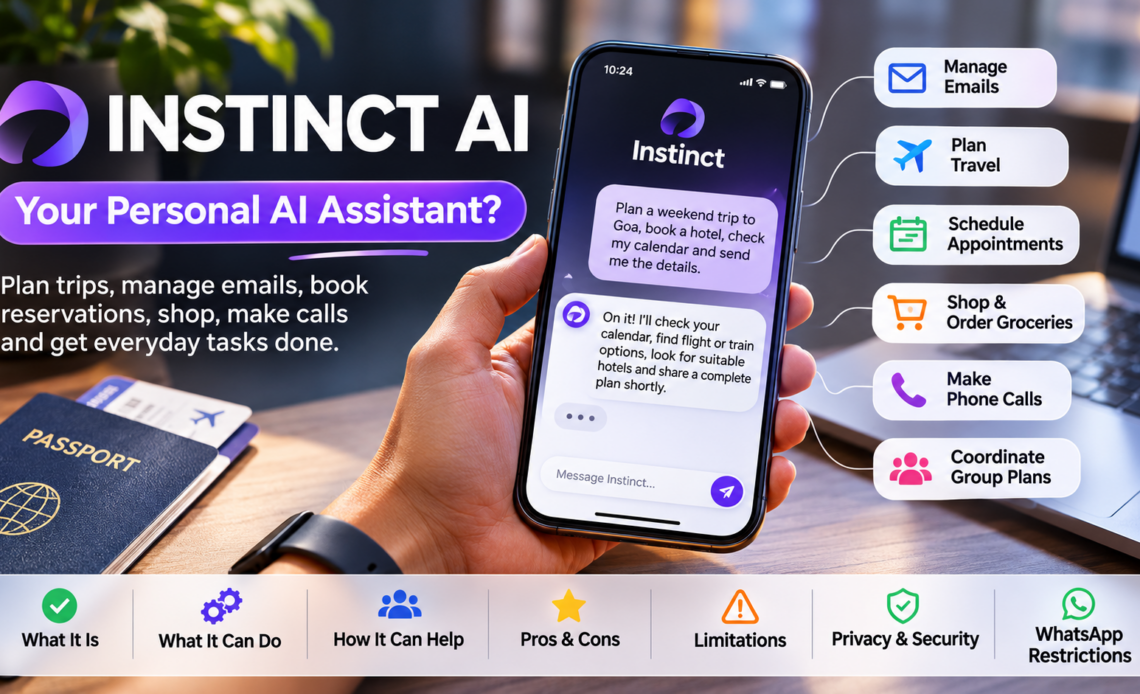
Instinct AI is a personal AI assistant designed to manage emails, book travel, make reservations, order groceries and handle everyday digital tasks. Here’s how it works, its key features, limitations, WhatsApp restrictions, privacy concerns and whether it is worth trying.
Artificial intelligence is evolving beyond answering questions.
Until recently, most people used AI tools to write emails, generate images, summarise documents or find information. Now, a new category of AI is emerging that promises to take things a step further: completing tasks on behalf of users.
Instinct AI is one such example.
Imagine asking an AI assistant to plan a holiday, find suitable travel options, organise your schedule and help manage the bookings. Instead of merely recommending what you should do, it attempts to perform the actual work.
That sounds convenient, but it also raises important questions.
What exactly is Instinct AI? What can it do? Does it work in India? Can you use it with WhatsApp Business? And is it safe to give an AI assistant access to your personal accounts?
Let’s take a closer look.
What Is Instinct AI?
Instinct AI is a personal AI assistant developed by Spear Street Technology, Inc., a startup founded by Noah Shinn.
Unlike a conventional chatbot, Instinct is designed to act on your behalf by interacting with digital services and applications.
It can understand requests, plan multi-step activities, use connected services and continue working on tasks rather than simply returning a response.
The service has been designed around familiar communication methods, including messaging and calling, rather than requiring users to spend their time navigating a complex AI application.
Instinct has been offered through an invite-based beta, with access and features subject to change.
Its main proposition is straightforward: tell your assistant what you need, and let it handle the work.
For example, you might ask it to:
- Find suitable flights for an upcoming trip.
- Organise your calendar.
- Find important emails and draft replies.
- Arrange restaurant reservations.
- Order groceries.
- Contact a business.
- Coordinate plans with friends.
The assistant is designed to use a computer and browser environment, along with supported integrations, to perform these activities.
The important distinction is that Instinct is built around task execution, not just conversation.
How Does Instinct AI Work?
Instinct combines AI reasoning, connected account information and tools that allow it to interact with digital services.
Here’s how it works in practice.
1. You give it an instruction
You explain what you want in everyday language through a supported communication channel.
For example:
“Find a hotel in Goa for two nights within my budget and check whether my calendar is free.”
2. It interprets your request
The assistant identifies your requirements, determines the steps involved and considers relevant information it can access.
3. It uses connected services
Depending on permissions, Instinct can access information from supported integrations and accounts.
Its documented Google Workspace integration includes Gmail, Google Calendar, Google Drive, Google Docs, Google Sheets, Google Slides and Google Tasks.
4. It performs the work
It can use available tools, websites and integrations to research, organise information and carry out permitted actions.
5. It reports progress and follows up
The assistant can communicate updates, request missing details or seek further input when necessary.
The process is not always completely automatic. Certain actions may require approval, additional verification or human intervention.
Also, an instruction to perform a task is not proof that the task has been completed successfully.
What Can Instinct AI Do? 8 Useful Applications
1. Manage Your Emails
Email management is one of the most practical applications of personal AI assistants.
If you receive dozens of messages every day, identifying important conversations and following up can consume considerable time.
Instinct can help with:
- Finding relevant emails.
- Summarising conversations.
- Identifying messages requiring attention.
- Drafting replies.
- Sending emails.
- Organising information.
- Following up on outstanding matters.
For example, imagine receiving an invitation to a technology launch event.
You could ask Instinct to summarise the invitation, identify the venue, extract the dates, find the registration deadline and help organise your travel.
Instead of manually searching through multiple emails, the assistant can coordinate the information.
However, always exercise care with outgoing emails, particularly those involving confidential information, negotiations or business commitments.
2. Plan Trips and Manage Travel
Travel planning involves several connected activities.
You need to compare transport options, find accommodation, check schedules, arrange bookings and keep track of updates.
Instinct is designed to help coordinate these activities.
It can potentially assist with:
- Finding flights and train options.
- Comparing travel alternatives.
- Researching accommodation.
- Organising itineraries.
- Managing check-in workflows.
- Retrieving boarding passes.
- Tracking travel updates.
- Helping with changes and rebooking.
A September 2026 hands-on review by Gadgets Now described using Instinct for a multi-airline journey from Delhi to Hawaii.
The assistant handled several airline check-ins, passport information, boarding passes and travel updates. However, one airline still required assistance at the airport counter.
This demonstrates the potential of AI agents while highlighting an important limitation: not every travel process can be completed digitally.
Travel bookings also involve financial commitments, cancellation policies and changing fares. Verify the final arrangements carefully.
3. Shop Online and Order Groceries
Shopping is another area where an AI assistant could save time.
You could ask Instinct to help order groceries, find household essentials or purchase products based on your requirements.
Potential applications include:
- Finding suitable products.
- Comparing shopping options.
- Ordering groceries.
- Tracking deliveries.
- Assisting with returns.
- Contacting customer support.
For example, you could ask it to prepare a grocery order for the week within a specific budget.
However, AI recommendations do not automatically mean the best price or product.
Check quantities, specifications, sellers, delivery fees and the final order amount.
Purchases should be made only through authorised workflows and appropriate approval controls.
4. Make Phone Calls
One interesting development is Instinct Concierge, a feature designed to make phone calls on behalf of users for supported tasks.
Consider these situations:
- Making restaurant reservations.
- Enquiring about appointment availability.
- Contacting service providers.
- Asking businesses about their services.
- Arranging certain bookings.
Instead of calling the business yourself, you could delegate the task.
This is particularly useful for activities that still require speaking to someone.
However, feature availability and supported calling workflows may vary.
A call being placed does not necessarily mean a reservation or request has been confirmed.
5. Manage Appointments and Schedules
Instinct can use connected calendar information to help organise your day.
It can potentially help with:
- Finding available meeting slots.
- Scheduling appointments.
- Adding calendar events.
- Identifying scheduling conflicts.
- Managing reminders.
- Coordinating changes.
Imagine having a business meeting, a doctor’s appointment and a family commitment on the same day.
An assistant with access to your calendar can help coordinate the schedule rather than requiring you to manage everything manually.
6. Use Its Own Email Address
Instinct has introduced the ability to use its own email address for certain workflows.
This can be useful when dealing with businesses, purchases and administrative tasks.
For example, if you need to return a product, the assistant could help contact the seller, provide relevant order information and follow up on the return process.
Using a separate assistant-managed email address may also reduce the need to share your primary email address in certain situations.
However, it introduces a different concern: businesses may be communicating with an AI-managed account, and the user needs to understand how those communications are handled.
7. Coordinate Group Activities
Instinct has introduced a group-chat experience that allows users to involve the assistant in shared activities.
Imagine a group of friends planning a weekend trip.
The assistant could help coordinate:
- Travel dates.
- Group preferences.
- Budgets.
- Restaurant options.
- Meeting points.
- Shared activities.
The goal is to reduce the back-and-forth that usually happens when organising a group.
Instinct has described safeguards around sharing information between personal assistants and group experiences, including permission requirements.
Nevertheless, users should avoid sharing private information in group conversations without understanding who can access it.
8. Remember Preferences and Follow Up
A personal assistant becomes more useful when it understands your preferences and ongoing tasks.
Instinct is designed to maintain relevant context, including information users make available to it.
This could help with:
- Travel preferences.
- Important contacts.
- Upcoming appointments.
- Shopping preferences.
- Ongoing tasks.
- Previous interactions.
The ability to follow up is particularly useful.
Instead of remembering every outstanding task yourself, you could delegate certain activities and receive updates when something needs attention.
However, persistent context also makes privacy and data retention important considerations.
How Can Instinct AI Help Different Users?
Professionals: Manage email, meetings, travel and routine administration.
Content creators: Organise event invitations, track unanswered brand communications and coordinate travel schedules.
Frequent travellers: Manage itineraries, bookings and travel updates.
Families: Coordinate appointments, household shopping and shared activities.
Everyday users: Reduce repetitive digital tasks and spend less time navigating websites.
For creators and businesses, there is an important qualification: Instinct’s service terms and intended use need to be checked before relying on it for commercial or client-facing work.
An AI assistant that is convenient for personal travel planning may not automatically be suitable for confidential business operations.
Instinct AI vs ChatGPT and Other AI Assistants
How is Instinct different from ChatGPT, Gemini or Claude?
The distinction is not that other AI tools cannot perform actions. Modern AI assistants also support tool use, integrations and agentic workflows.
The difference is in the product experience and how the assistant is designed to operate.
| Feature | Traditional chatbot experience | Instinct AI |
|---|---|---|
| Answer questions | Yes | Yes |
| Generate content | Yes | Can assist |
| Use connected information | Depends on integrations | Supported integrations |
| Perform multi-step tasks | Depends on tools | Core product focus |
| Interact with websites | Tool-dependent | Designed for it |
| Make phone calls | Product-dependent | Concierge feature |
| Continue working on tasks | Product-dependent | Core proposition |
| Messaging-based assistant | Varies | Key part of its experience |
The most useful way to evaluate an AI assistant is not by counting features.
It is by asking: Can it complete the task reliably, with appropriate permission and clear confirmation?
Instinct AI and WhatsApp: An Important Limitation
This is an important section for readers, particularly in India.
Instinct has been associated with messaging-based access, including WhatsApp. However, WhatsApp availability involves platform policies, supported countries and account eligibility.
What Changed in Meta’s WhatsApp AI Policy?
In October 2025, Meta announced changes restricting general-purpose AI providers from offering their assistants through the WhatsApp Business Platform when AI is the primary service being delivered.
The restrictions took effect on January 15, 2026, with new accounts restricted earlier.
This policy affected services that used WhatsApp’s business infrastructure to provide general-purpose AI assistants.
However, WhatsApp subsequently published Terms of Service for Use of Third Party Agents, last updated August 25, 2026.
WhatsApp now provides a framework for users to connect certain third-party agents through its platform.
Its Help Center states that:
- Users can connect up to five third-party agents.
- Agent access is optional.
- Agents can access what users share with them in their agent conversations.
- The experience is available only in limited countries.
- Availability may differ even among users in the same country.
This later framework is important and means the original policy announcement should not be treated as the complete picture of WhatsApp’s current agent experience.
Does Instinct Work With WhatsApp Business Accounts?
Do not confuse WhatsApp Business account compatibility with WhatsApp’s policy on AI agents.
These are separate questions.
A user having a WhatsApp Business account does not, by itself, establish whether they are eligible to connect a third-party agent.
The relevant questions are:
- Does Instinct currently support the user’s account type?
- Is the service available in that country?
- Is Instinct accessible through the applicable WhatsApp agent experience or another supported integration?
- Does the current onboarding process permit that setup?
Instinct’s supported account types and eligibility should be confirmed directly before making a definitive compatibility claim.
For readers who use WhatsApp Business for professional communications, this is particularly important.
Do not migrate your business number, change your account type or attempt unofficial workarounds without confirmation.
Can WhatsApp Users Trust Their Conversations With AI Agents?
There is another important privacy distinction.
WhatsApp states that conversations with third-party agents through its agent platform are not end-to-end encrypted in the same way as personal WhatsApp conversations.
The agent provider receives and processes messages to provide its service.
This means conversations with third-party AI agents should not be treated as equivalent to private chats with friends and family.
Avoid sharing passwords, payment credentials, confidential documents or sensitive personal information unless you fully understand the applicable safeguards and data handling practices.
Advantages of Instinct AI (Pros)
Here are the major advantages of this approach.
1. Convenience: Users can communicate naturally instead of navigating multiple applications.
2. Task execution: It aims to perform tasks rather than simply explain how to do them.
3. Multi-step automation: It can coordinate several activities to achieve a larger objective.
4. Personalised assistance: Connected information can help it understand user preferences.
5. Proactive follow-ups: It can continue working and provide updates.
6. Phone-call capabilities: Concierge extends the assistant experience to certain activities requiring phone calls.
7. Group coordination: Shared planning can become easier.
8. Reduced app switching: Users can delegate activities without manually navigating every service.
Limitations and Cons of Instinct AI
Instinct’s capabilities are promising, but there are several limitations.
1. AI Can Make Mistakes
The assistant may misunderstand instructions, choose incorrect information or take unintended actions.
This matters particularly when the task involves purchases, bookings or messages.
2. Website Automation Is Not Always Reliable
Websites may introduce:
- CAPTCHA challenges.
- Two-factor authentication.
- Login restrictions.
- Bot detection.
- Interface changes.
- Identity verification.
These can interrupt a workflow.
3. Not Every Task Can Be Automated
Some activities require human involvement.
Examples include physical document verification, certain airport procedures and complicated customer service requests.
4. It Depends on Supported Integrations
The assistant cannot access every application or service.
Its capabilities depend on supported integrations, permissions and regional availability.
5. Messaging Channels Can Become Unavailable
Instinct depends partly on services operated by third parties.
A messaging platform may introduce new policies, limit an integration or experience an outage.
On November 1, 2026, Instinct users reported WhatsApp response problems.
The following day, founder Noah Shinn attributed the disruption to a configuration issue that interrupted payments to a service provider. He said the problem was resolved.
This incident illustrates another practical limitation: even if the AI agent itself is functioning, the channel used to reach it may not be.
A reliable assistant should ideally offer suitable alternatives when a communication channel is unavailable.
6. Access Is Not Universal
Instinct has operated through invite-based access and evolving availability arrangements.
Features and regional eligibility may change.
A feature available to one tester does not necessarily mean it is available to every user.
7. It Requires Oversight
The assistant may be able to act independently, but users still need to monitor its actions.
AI automation does not eliminate accountability.
Is Instinct AI Safe? Privacy and Security Explained
This is one of the most important questions to consider.
An AI assistant that can interact with emails, documents, messaging and accounts may handle sensitive information.
The benefits of personalisation must be balanced against privacy and security.
What Information Can Instinct Access?
Depending on permissions and the services you connect, Instinct may process:
- Emails and email metadata.
- Calendar information.
- Documents and files.
- Messages you share with the assistant.
- Information from connected accounts.
- Voice and audio data, if enabled.
- Usage information.
The precise scope depends on your setup.
Is My Data Used to Train AI Models?
Instinct’s Privacy Policy distinguishes between different types of information.
Its policy states that Google Workspace and Photos API user data are not disclosed to third-party AI services for model training or secondary purposes.
It also states that Vault materials are excluded from AI model training.
However, other user materials and usage data may be used to develop and improve its technology, including AI model training, subject to the policy’s stated settings and exceptions.
The policy describes an opt-out, but opting out does not necessarily reverse training that has already taken place.
This distinction matters. A privacy statement should not be simplified into a blanket claim that all information is either used or never used for training.
Read the current Instinct Privacy Policy before connecting accounts.
What Happens When You Disconnect an Account?
Disconnecting an integration and deleting information previously collected from it are not necessarily the same thing.
Instinct’s documentation provides mechanisms to revoke access and request deletion of information collected through supported integrations.
Users should check the relevant deletion procedure and verify what information is retained.
Do not assume that disconnecting an account automatically removes previously indexed information.
Can an AI Assistant Be Tricked?
AI agents can encounter misleading instructions in emails, documents or websites.
This is a form of risk commonly associated with prompt injection.
For example, a malicious email might contain instructions attempting to persuade the assistant to disclose information or perform an unwanted action.
The assistant must distinguish between the user’s actual instructions and untrusted content it encounters.
This is particularly important when an agent has access to email, files or purchasing workflows.
What About Passwords and Payments?
Instinct has supported a 1Password integration for certain login workflows.
Credential integrations can reduce the need to share passwords directly, but they do not eliminate all risks.
Payment permissions also deserve careful attention.
Before allowing purchases, users should understand:
- What payment methods are accessible.
- What actions require approval.
- Whether spending limits are available.
- What happens when a purchase goes wrong.
- How refunds and cancellations are handled.
Who Is Responsible If Instinct Makes a Mistake?
Instinct’s Terms of Service contain provisions authorising the service to act as the user’s agent for certain transactions and agreements.
They also describe user responsibilities and limitations of the company’s liability.
Some actions may create binding commitments.
This makes it important to read the terms carefully, particularly before allowing the assistant to make purchases, sign agreements or handle important business matters.
How to Use Instinct AI More Safely
If you decide to try Instinct, start with simple tasks.
- Review the privacy policy and service terms.
- Connect only the services you need.
- Understand account permissions.
- Check available AI training settings.
- Use secure credential integrations where supported.
- Keep purchase permissions appropriately limited.
- Review important outgoing emails.
- Verify bookings and cancellations.
- Understand data deletion procedures.
- Monitor activity and communication channels.
For sensitive tasks involving finances, health, legal matters or confidential business information, human oversight is essential.
Is Instinct AI Available in India?
Yes, Instinct AI is available in India.
The service is currently in invite-based early access.
Check the latest onboarding requirements and supported channels at:
Is Instinct AI Free?
Instinct has been reported as free during its beta period.
However, its long-term commercial pricing should not be assumed.
The Terms of Service contain provisions for paid features and fees.
Before depending on it for everyday tasks, check current pricing, transaction-related costs and the applicable service terms.
Instinct AI vs a Human Personal Assistant
Instinct could be useful for repetitive digital tasks.
It may help with emails, appointments, research, reservations and travel planning.
However, a human assistant can apply judgement, negotiate unusual situations, understand sensitive interpersonal context and take responsibility in ways an AI cannot reliably replicate.
The two should not be treated as interchangeable.
The most effective approach may be to use AI for routine digital work while keeping human oversight for important decisions.
Final Verdict: Is Instinct AI Worth Trying?
Instinct AI represents an interesting shift in how people use artificial intelligence.
Instead of simply asking questions, users can delegate tasks.
The possibility of having one assistant coordinate travel, email, appointments, shopping and everyday administration is compelling.
For people who spend considerable time managing digital activities, this approach could save meaningful effort.
However, three things determine whether it will be genuinely useful:
Reliability: Can it complete tasks correctly?
Availability: Can you access it through supported services in your region?
Trust: Are its privacy controls and permissions appropriate for your needs?
The WhatsApp situation also highlights an important point: AI assistants depend on communication platforms and integrations that they do not control.
A useful AI agent needs more than impressive demonstrations. It needs dependable access, transparent permissions, clear confirmation and sensible safeguards.
Our take: Instinct AI is worth watching as an example of agentic AI, but users should approach it as an evolving personal assistant rather than a fully autonomous replacement for human judgement.
For now, begin with low-risk tasks, verify its results and give it only the access it genuinely needs.
The future of personal AI may not be about which assistant gives the smartest answer. It may be about which assistant can get the job done reliably and safely.
Frequently Asked Questions
What is Instinct AI used for?
Instinct AI is designed to handle everyday digital tasks such as email management, travel planning, shopping, reservations, scheduling and certain phone calls.
Is Instinct AI a chatbot?
It has a conversational interface, but it is designed primarily as a task-oriented AI agent that can use tools and connected services.
Does Instinct AI work with WhatsApp?
Instinct has offered WhatsApp-based access, but availability depends on current platform arrangements, supported countries and account eligibility. Verify current access before relying on it.
Can I use Instinct with WhatsApp Business?
Do not assume compatibility. A WhatsApp Business account and eligibility to connect a third-party AI agent are separate questions. Check Instinct’s current supported account types and onboarding requirements.
Are WhatsApp conversations with AI agents end-to-end encrypted?
WhatsApp states that conversations with third-party agents through its agent platform are not end-to-end encrypted in the same way as personal conversations.
Can Instinct AI access Gmail?
Instinct documents Google Workspace integration, including Gmail, subject to the permissions granted.
Can Instinct AI make purchases?
It is designed to support shopping and purchasing workflows. Payment methods, approvals and availability depend on the supported setup.
Is Instinct AI free?
It is free during its beta as of now, but future pricing and paid features should be checked through the official service terms.
Is Instinct AI available in India?
Yes, it is available in India.
Can Instinct replace a personal assistant?
It can automate routine digital tasks, but it cannot reliably replace human judgement, accountability and physical assistance.
Official Resources and Further Reading
- Instinct Official Website
- Instinct Privacy Policy
- Instinct Terms of Service
- WhatsApp Third-Party Agent Terms
- WhatsApp Help Center: Third-Party Agents
- TechCrunch: WhatsApp’s policy change for AI chatbots
- TechCrunch: Instinct’s privacy and security concerns
- Gadgets Now: Instinct AI hands-on review
- Moneycontrol: Instinct’s WhatsApp service disruption
Editorial note: Product features, availability, platform policies and pricing may change. This article reflects information reviewed as of November 2, 2026. Individual features may be subject to beta access, regional eligibility and third-party service restrictions.

