
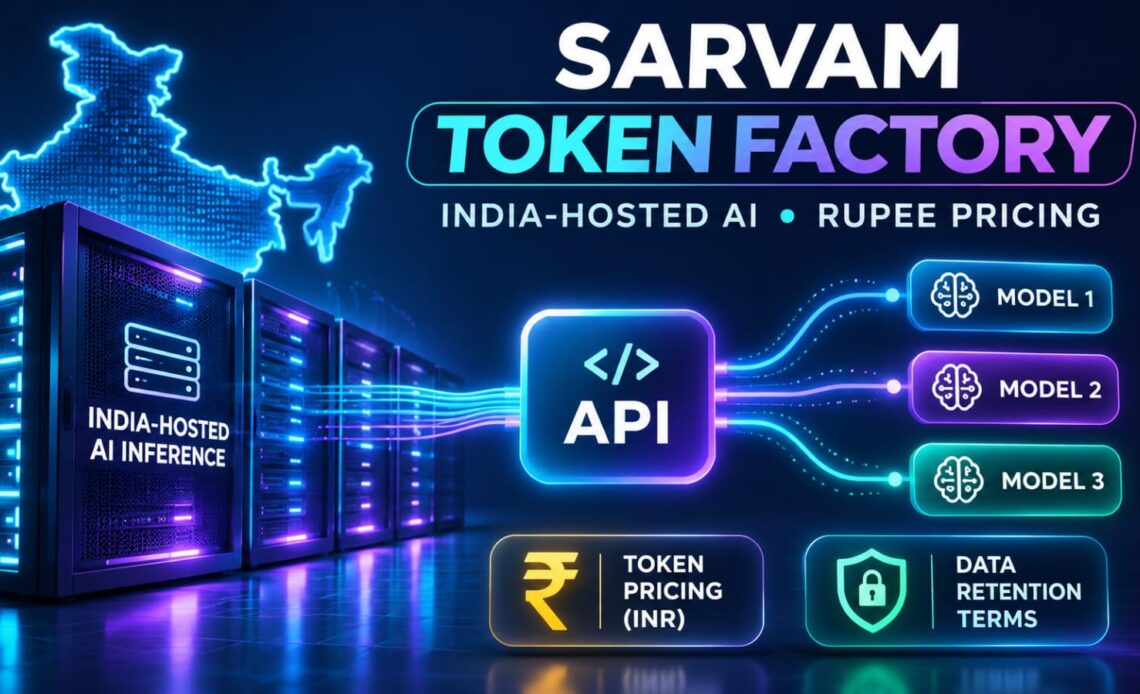
Sarvam Token Factory gives developers a way to run Sarvam’s own models and global open-weight models through one API, using GPU infrastructure in India. The useful question is less whether it is “India’s OpenRouter” and more whether its model choice, rupee billing and deployment terms fit an application’s workload.
Sarvam announced general availability on November 16. This is an inference service: it runs models for an application. It is not a new consumer chatbot, and the global models it hosts were not all trained by Sarvam.
What developers get through one API
The launch announcement lists Sarvam 105B alongside GLM 5.3, GLM 5.3 Flash, DeepSeek V4.1 Flash 1017, DeepSeek V4 Pro, Kimi K3.1 Pro and Gemma 4 31B. Sarvam says these are served from GPU clusters in India through an OpenAI-compatible API.
For a developer, that can reduce the work of connecting to several separate providers. However, API compatibility is not a promise that an application can switch models without changes. Teams still need to test response formats, tool use, context limits and how each model behaves on their own tasks.
Rupee prices need a workload, not a headline
The current catalogue lists DeepSeek V4.1 Flash at Rs 14 per million input tokens and Rs 55 per million output tokens. Sarvam’s launch post describes these as introductory Standard-endpoint rates, intended for background and batch work. It separately describes a faster Interactive endpoint at Rs 25 for input and Rs 105 for output per million tokens.
Sarvam 105B is listed at Rs 10 per million input tokens and Rs 25 per million output tokens. The catalogue states that prices exclude GST. Cached-input rates are separate, so a model’s lowest displayed number should not be mistaken for the price of all requests.
A token is a unit of text processed by the model, not a fixed number of questions. A short classification task and a long document analysis can have very different bills. Retries, output length and repeated context also matter when estimating the cost of a feature.
Read latency claims in context
Sarvam publishes speed and infrastructure comparisons, including tests from AWS Mumbai and measurements under different levels of concurrent use. Those are company-run benchmarks, not Tech Raman’s independent tests.
The distinction between time to first token and output speed matters. An interactive assistant needs to start replying quickly; a background job may care more about throughput and price. Performance also depends on prompt length, endpoint choice, caching and load. A headline improvement from one benchmark is not a guarantee for every application.
India hosting is not the same as automatic zero retention
Sarvam says Token Factory runs on its GPUs in India, with shared or dedicated capacity. Its product page says zero data retention is available on request. Under an agreed zero-retention arrangement, prompts and responses are not retained, while operational logs are scoped separately in the deployment terms.
That wording is worth checking before sending sensitive material. India-based processing does not, by itself, settle retention, access controls, contractual obligations or every compliance requirement. Teams should confirm the arrangement that applies to their account rather than assume the strictest terms are enabled by default.
Where Token Factory could fit
The service is worth evaluating for teams that want an India-hosted model API, rupee pricing and a choice of open-weight models without running their own GPU fleet. Sarvam also says it offers on-premise deployment for enterprises.
The sensible next step is a small evaluation using representative, non-sensitive tasks: compare answer quality, failure behaviour, response time and the full bill. Model availability and attractive token prices are useful starting points. Production suitability still depends on how the service performs inside the application that will use it.

