

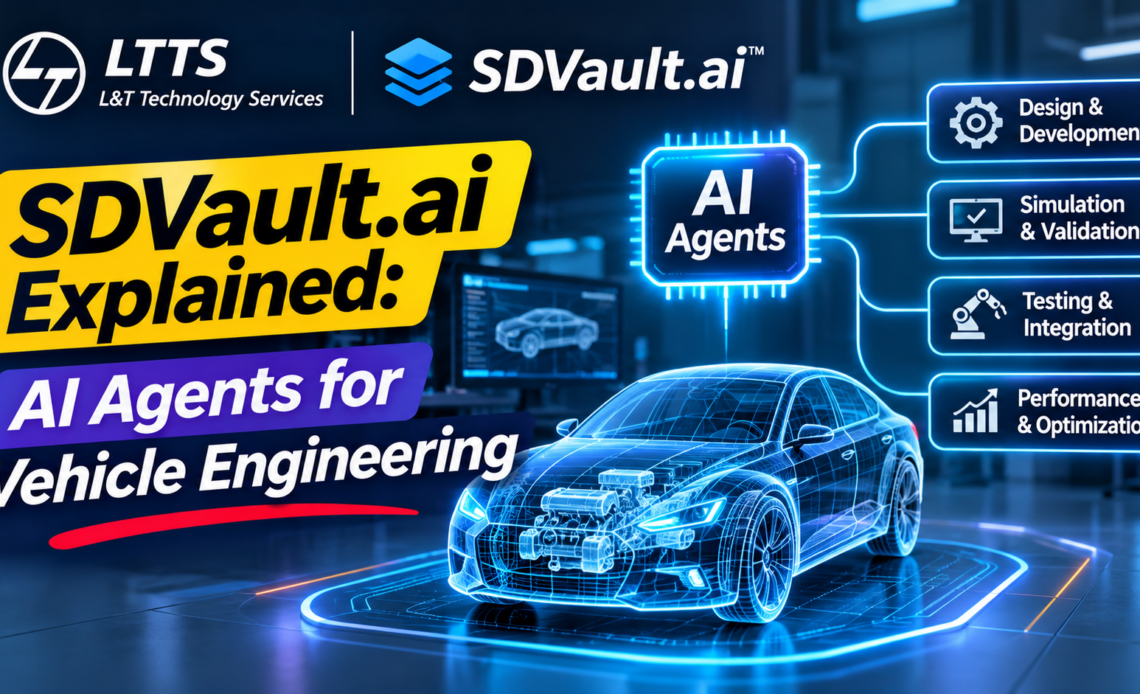
L&T Technology Services has launched SDVault.ai, an engineering and assurance platform for software-defined vehicles. Announced on November 23, it brings more than 250 domain-aware AI agents together with rule-based automation across the vehicle software development cycle.
The important distinction is that this is a toolchain for automotive manufacturers and Tier-1 suppliers. It is not an in-car assistant, a driver-assistance feature or a consumer software update.
What SDVault.ai connects
Vehicle software development involves more than generating code. A changed requirement can affect system architecture, safety analysis, software, tests and the evidence used to approve a release. Teams need to understand those connections before a change reaches a vehicle programme.
LTTS says SDVault.ai connects 12 engineering domains, from requirements and electrical/electronic architecture to functional safety, cybersecurity, software intelligence, verification and embedded debugging. It also covers virtual electronic-control-unit validation, trace and network analysis, root-cause work, and regression and release assurance.
The company describes a connected engineering thread linking requirements and architecture with code, tests, failures, corrective actions and release evidence. The intended benefit is to show what a change affects and whether the affected parts have been checked.
Why engineers remain in charge
According to LTTS, the platform combines AI agents with deterministic automation. The latter means rule-based processes whose behaviour is intended to be repeatable, an important distinction for safety-critical engineering.
LTTS explicitly says engineers retain control of engineering decisions, verification and certification. The launch should therefore not be read as a claim that AI can independently certify a vehicle or remove the need for safety checks.
The platform is modular. Customers can use it across the development cycle or add selected parts alongside their existing toolchains. LTTS also says sensitive engineering data can remain in customer-controlled environments. Specific deployment arrangements, data access and integration requirements still need to be agreed for each customer.
What the 30-40% figure actually means
LTTS reports that early pilots indicated the potential for teams to absorb 30-40% additional engineering workload. It also cites selected ticket-triage workflows falling from approximately four hours to 10 minutes.
Those are company-reported pilot results. They are not a promise that every vehicle programme will finish 40% faster, that development costs will fall by the same amount, or that a complete safety-validation process takes 10 minutes.
The release does not provide the pilot sample size, a detailed test method or independently verified results. Buyers should ask which tasks were measured, how much human review remained, what the baseline included and whether the same gains hold with their own software and tools.
What automotive teams should check
The practical questions are integration and evidence. Can the tool work with the team’s requirements, code and test systems? Can an engineer trace an AI-assisted recommendation back to its inputs? What happens when a generated fix is wrong, and which approvals prevent an unverified change from progressing?
LTTS says it has filed 15 patents related to SDVault.ai. The announcement does not publish a price list or a general self-service availability date.
For readers following AI in engineering, the useful part of this launch is the attempt to connect software changes with verification evidence. The number of agents is less informative than whether the tool produces an audit trail engineers can actually use.

