

Siemens has launched its Eigen Engineering Agent in India, bringing an AI tool for industrial automation engineering to a market where the company says it has already piloted it with more than 16 customers. Unlike a general chatbot that hands over a code suggestion, Eigen works inside Siemens’ engineering environment and uses the actual project context to carry out tasks.
The India announcement is dated November 18. This is not the product’s first global release: Siemens announced general availability at Hannover Messe in April 2026. The local launch matters because it adds named Indian deployment examples, rather than introducing an entirely new category overnight.
What does Eigen actually work on?
The agent connects to TIA Portal, Siemens’ Totally Integrated Automation engineering platform. Siemens says it can work on programmable logic controller (PLC) coding, human-machine interface (HMI) visualisation and device configuration. Its project awareness includes data structures, code blocks, parameters and component relationships.
In simpler terms, PLC code is part of the logic that controls a machine, while an HMI is the interface an operator uses to monitor or interact with it. These jobs depend on the specific machine and project standards. A plausible answer from a general AI model is not enough.
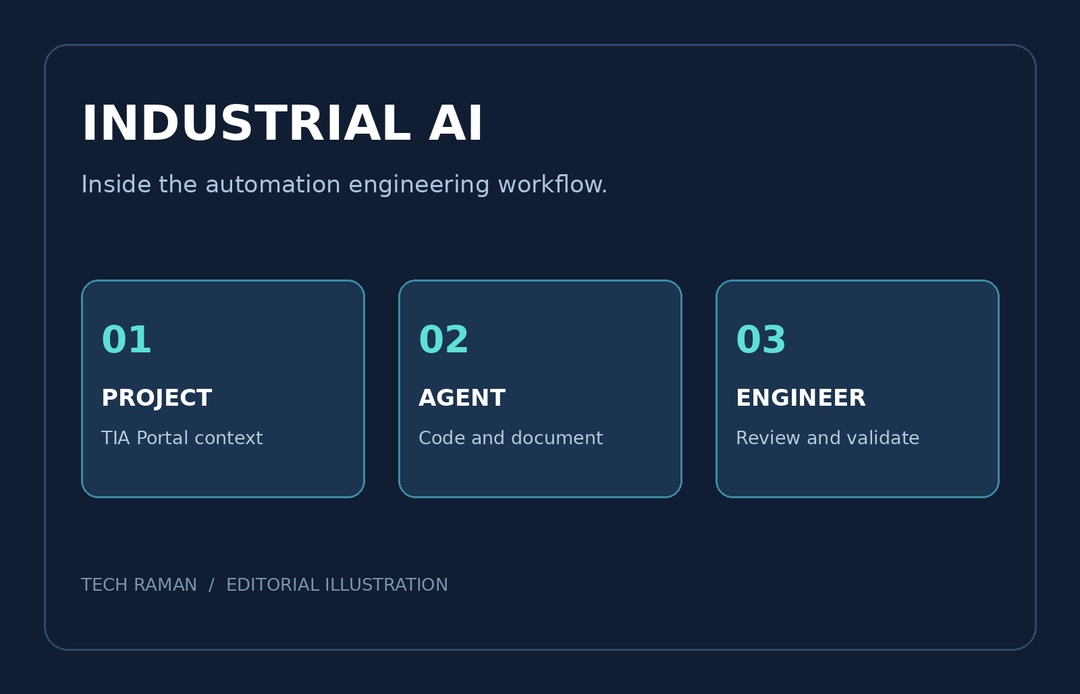
Siemens describes Eigen as breaking a task into steps, executing them, checking the output against project requirements and iterating before presenting results to an engineer for review. That review boundary matters: an agent validating its own work is not the same as a site accepting a machine as safe to run.
What the Indian examples show
Pelican Rotoflex, a manufacturer of printing and converting machinery for flexible packaging, is one of the Indian customers named in the announcement. Siemens says the company uses Eigen in TIA Portal for code generation, documentation, code interpretation and targeted issue resolution, alongside its own automation and programming expertise.
The other named example is Z System Intelligent Controls. Siemens describes its use of AI-assisted PLC code understanding, logic generation, validation and automated documentation. The release cites potential reductions of over 50% in repetitive engineering effort and 20-30% productivity improvement for that example.
These are supplier-reported customer results, not independent tests by Tech Raman. They point to repetitive software and documentation work as a practical starting point. They do not establish that every factory, team or legacy project will see the same gain.
How to read the headline performance claims
Siemens’ broader product claims include workflows completed two to five times faster than manual alternatives, up to 80% higher solution quality and 50% greater engineering efficiency. These figures describe different measures and should not be added together or translated into an equivalent increase in factory output.
The India release does not provide a public local price or a detailed test methodology for each number. A team assessing the product should ask for the applicable subscription terms, supported TIA Portal versions, data handling arrangements and results on a representative project before building a savings forecast.
Where it could be useful, and what still needs checking
For a team already working in TIA Portal, the appeal is reducing time spent understanding unfamiliar code, generating repeatable logic and keeping documentation aligned. It is less useful to judge Eigen as if it were a standalone chatbot for any engineering system.
For a pilot, choose a bounded task with an existing test process. Have engineers check generated logic against the project standards, confirm how data is handled, and retain the normal simulation, safety and commissioning checks before deployment. Those are practical evaluation steps, not a claim that Siemens has removed the need for engineering judgement.
The India launch makes Eigen worth watching as a workflow product with local use cases. Whether it earns a place in a particular engineering team will depend on compatibility, review effort and measured results, not the word autonomous in a launch headline.
Sources: Siemens’ India announcement and April global launch. Featured image: Tech Raman editorial illustration, not a Siemens product screenshot.

