

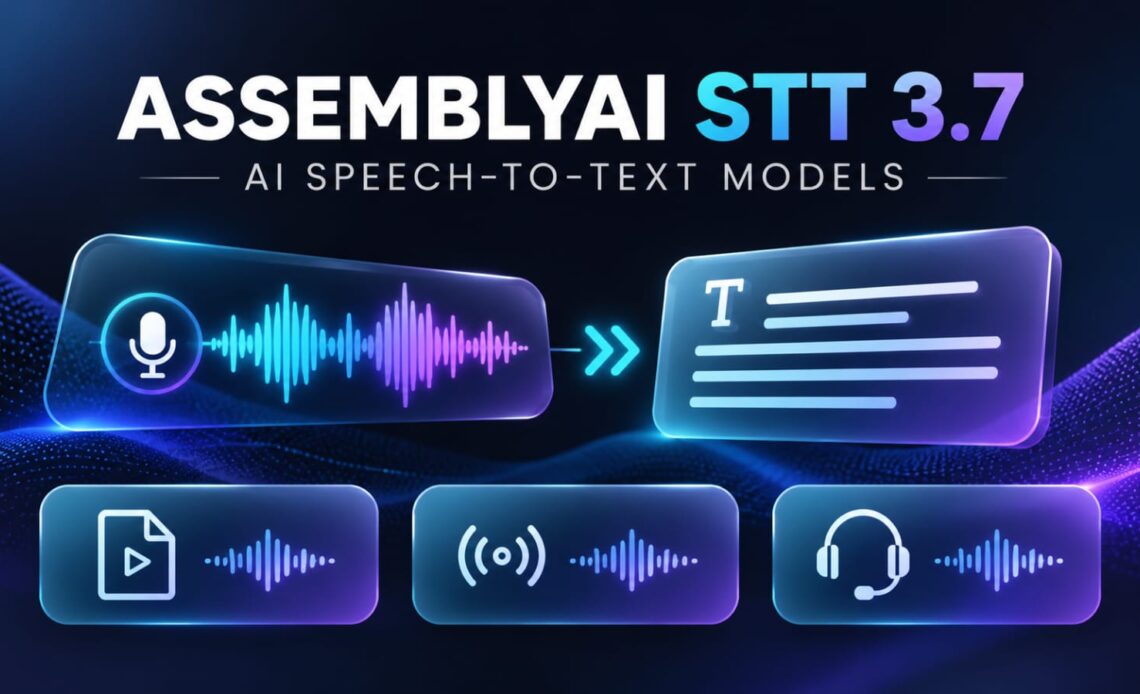
AssemblyAI has released its STT-3.7 speech-to-text family, separating three jobs that are often grouped together: transcribing a recording, captioning a live conversation and listening to someone who expects a voice agent to answer.
Announced on November 18, the update is aimed at developers building transcription and voice features. For creators and businesses evaluating those tools, the practical issue is which model fits the audio, how speakers and languages are handled, and what the quoted hourly price includes.
Three models for different kinds of waiting
AssemblyAI-STT-3.7 is the pre-recorded model for files that can be processed before anyone needs the result. The company lists it at $0.21 per audio hour. That is the relevant starting point for recorded interviews, podcasts and other material where the transcript matters more than an immediate reply.
AssemblyAI-STT-3.7-Realtime is intended for live conversations, meetings, calls and captions, at $0.30 per hour. It produces speaker labels when a turn ends. Those labels matter when the transcript needs to distinguish who said something, rather than simply collect the words.
AssemblyAI-STT-3.7-Realtime-Agent is priced at $0.45 per hour and is designed for conversations with a voice agent. Its job is to provide speech input that the agent can act on while the conversation is happening. It is not simply the same recorded-audio service running faster.
Why the distinction matters
A meeting transcript can wait for the end of a speaking turn to settle a speaker label. A voice assistant needs to decide when someone has finished and whether a short response, name or number is enough to act on. Confusing background speech with the person addressing the assistant can also lead to an unwanted interruption.
AssemblyAI says the agent model reduces background speech and improves how these interactions are captured. Those are company claims, not results from a Tech Raman test. Teams should evaluate them with their own audio, especially for short replies, noisy rooms and conversations that switch languages.
32 languages, with a qualified fallback claim
All three models are listed as supporting 32 languages with automatic language detection. For pre-recorded audio, developers can add Universal-2 as a fallback to reach 99 languages in total. That does not mean STT-3.7 itself has native support for 99 languages, or that the same fallback applies to both realtime models.
The release also discusses code-switching, where speakers change languages within a conversation, and fewer unwanted changes of language or script in the output. These improvements need to be checked on the accents, vocabulary and language combinations a tool will actually encounter. A language-count headline is not enough to establish transcript quality.
Speaker labels deserve their own check
The company says its new diarization model, which separates speakers, is being rolled out across its models and supported languages. It reports improvements on short clips as well as longer recordings.
For an interview workflow, that is worth examining separately from word accuracy. A transcript can contain the right sentence but attribute it to the wrong person. Before turning it into subtitles, quotes or meeting notes, a human still needs to check names, numbers and speaker changes against the audio.
What existing users should verify
The pre-recorded model’s $0.21 hourly price is unchanged from Universal-3.5 Pro, and AssemblyAI says existing pre-recorded rates carry over. The agent model’s $0.45 rate is unchanged from Universal-3.6 Pro Realtime. The lower-priced general realtime model is a different option, so the prices should not be treated as interchangeable.
Migration also changes transcript defaults. AssemblyAI says disfluencies and format_text now both default to true: fillers are retained, while numbers and dates are formatted in written form. Existing users should set these options explicitly if their editor, subtitle or summary workflow depends on a particular transcript style.
The current technical guidance says Universal-3 Pro and Universal-3.5 Pro for pre-recorded audio are deprecated, with a retirement date still to be announced. It separately lists February 1, 2027 for retirement of Universal-3.5 Pro Realtime. Developers should check the exact model name in their integration rather than assume every older Universal model has the same deadline.
For existing accounts that default to Universal-3.5 Pro or Universal-3 Pro, AssemblyAI says requests without an explicit speech_models setting will use STT-3.7 from December 8, 2026. That default change is not a retirement date. Accounts that default to Universal-2 are not upgraded automatically.
The release offers a useful way to choose: recorded material, live transcripts or an agent that must reply. A small test using real-world audio is still the best way to decide whether the new models improve the finished workflow, rather than just its benchmark score.

