
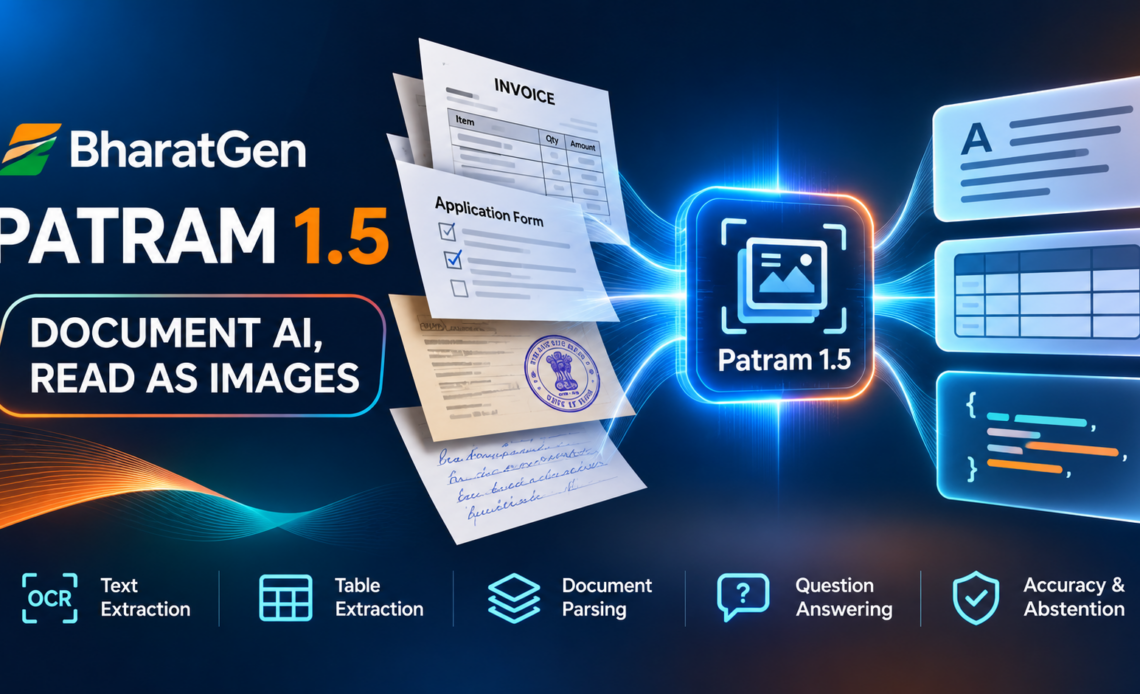
BharatGen has released Patram 1.5, a document-focused vision-language model that reads pages as images. It can extract fields, interpret tables and answer questions about a page without first depending on a separate text-only OCR stage. The open-weight model is aimed at developers building tools around scans, forms and other documents.
The release adds two named capabilities: prompt-controlled OCR, which BharatGen calls OCR 3.0, and abstention, where the model can flag missing, unreadable or conflicting evidence instead of always supplying an answer.
Image: Courtesy of BharatGen
What changes from ordinary text extraction?
A page’s meaning can depend on its layout, table structure or chart legend, not only its words. Patram treats the page itself as input. It can output plain text, Markdown, HTML or JSON, extract key-value pairs and answer questions spanning multiple images.
Prompt-controlled extraction lets a developer ask for a particular region or type of information, with chosen field names and output structure, rather than accepting a complete text dump. That could be useful for an invoice total, a form’s selected fields or a table embedded in a scan.
Abstention is meant to make unclear cases easier to route to a person. It does not establish that every remaining answer is correct. Financial, medical or identity records still need validation appropriate to their use.
What the benchmark score actually means
BharatGen reports an overall score of 83, tied with two much larger vision-language models in its comparison. The score gives equal weight to its own PatramBench results and public-benchmark results. It is not an accuracy percentage across all documents.
The evaluation covers 34 public benchmarks and 15 tasks from PatramBench. All comparison scores come from BharatGen’s own runs, not an independent audit. The model card says the public tests use English items; the blog also describes the selected PatramBench evaluation items as English. Those scores should not be read as proof of equal accuracy across every Indian language or handwriting style.
The model supports English and code-mixed pages. Its India-focused demonstrations are useful examples, but a deployment still needs testing on the actual scripts, scan quality and document layouts it will encounter.
Open weights, but check the access steps
The Hugging Face model card lists an Apache 2.0 licence, 7.8 billion parameters and a 32,768-token context. Despite the 7B name, 7.8B is the more precise size stated in its technical table.
The card currently describes the repository as gated: developers must accept its access conditions and use a Hugging Face token for downloads. The vLLM quick start lists an approximately 16GB download, along with setup requirements. Open weights do not mean there are no hardware, hosting or integration costs.
BharatGen also links a Playground for trying the model. For sensitive documents, check the hosted service’s data terms before uploading. Keeping documents on your own infrastructure is a separate deployment choice, not an automatic property of using a web demo.
Patram 1.5 is worth watching for its focus on document structure and uncertain answers. The next practical step is a trial on representative documents, measuring wrong extractions and missed fields as carefully as successful answers. Full evaluation details are in BharatGen’s launch post.

