
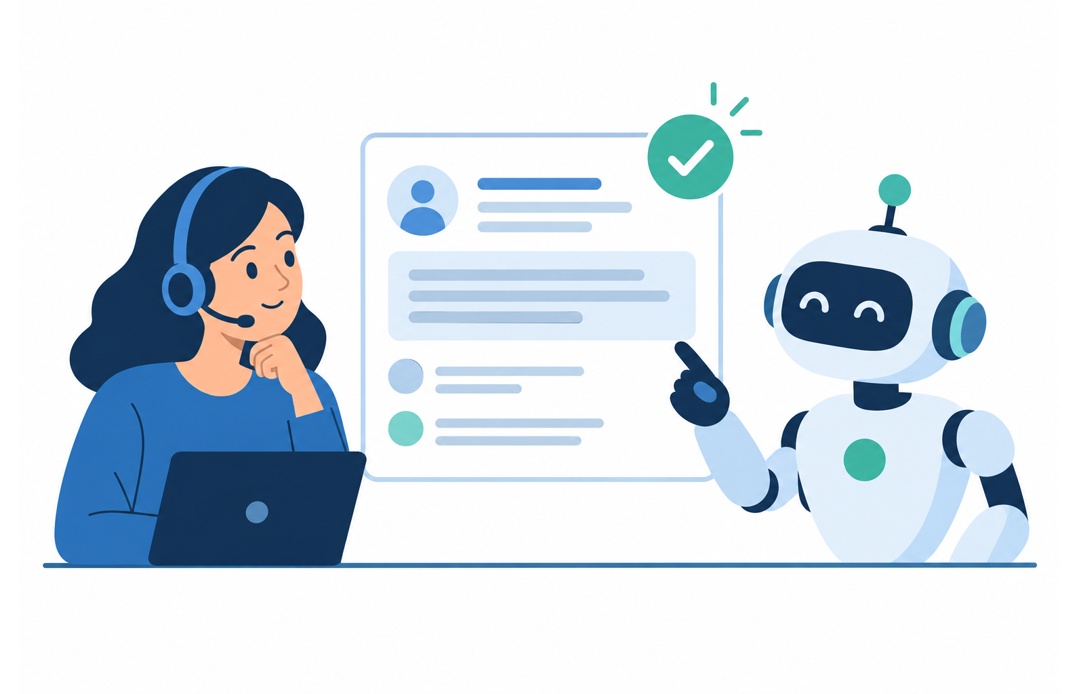
Featured image: conceptual illustration, not a Zoho Desk screenshot.
Zoho has announced Blended Agents for Zoho Desk, putting AI task execution and human hand-offs inside its customer-support platform. The practical idea is to move beyond a chatbot that answers questions: an agent can look up information or act across connected business applications, then pass a conversation to a person when it needs judgment.
The feature is available in India and across all paid Zoho Desk plans, according to Zoho’s November 16 announcement. There is no extra charge to create or deploy an agent, but that does not mean every AI interaction is free. Model usage is the important cost to check.
What Blended Agents can do
Powered by Zia Agents, the feature can use connected applications, uploaded documents and third-party tools to handle defined support tasks. Zoho gives examples such as retrieving order details, checking stock and updating customer accounts.
When human intervention is needed, the agent can transfer the conversation with its history and context. A support representative can also pause AI execution to review or approve an action before it goes ahead.
That distinction matters. A useful hand-off should not make a customer explain the same problem again. And permission to answer a question should not automatically mean permission to change an account. Teams considering the feature should check which actions their agents can take and where approval is required.
Included agent creation, separate model usage
Zoho says customers using its hosted models receive a monthly allowance of up to 30 million free tokens, depending on their tier. The headline number is a maximum, not a flat allowance for every plan.
Customers can instead bring an API key for their preferred model. Zoho says it does not add a charge for that route, but the customer pays the model provider for usage. Businesses should check their plan’s token allowance and model charges before treating the feature as a no-cost replacement for existing support tools.
For its in-house hosted models, Zoho says data remains in its local data centres and is not used to train its AI models. That statement should not be assumed to describe every third-party model arrangement.
More than the chat window
Zoho also describes behind-the-scenes uses: spotting repeated customer issues, alerting the relevant team, helping prepare knowledge-base content and flagging a technician’s scheduling conflict before a customer is left waiting. These are the company’s examples, not results from our testing.
The announcement includes Automation Studio, a visual workflow builder with branches, parallel actions, delays and linked action outputs. That starts with the Professional edition. Workstation, which lets representatives rearrange their ticket workspace, is an Enterprise feature. Those edition limits are separate from the wider availability of Blended Agents.
What businesses should ask before switching
The useful questions are fairly concrete: does it connect to the systems your team actually uses, what can it change without approval, does the hand-off retain the full context, and what happens when an integration or model is unavailable?
Zoho’s announcement describes the features and pricing structure, but it does not establish an independent improvement in resolution time or customer satisfaction. Those results will need to be measured against each team’s existing support process.
Sources: Zoho Desk Blended Agents product page and Zoho’s November 16 announcement.

